What Is Active Learning? Benefits, Examples, and Why It Matters for Student Success
Introduction
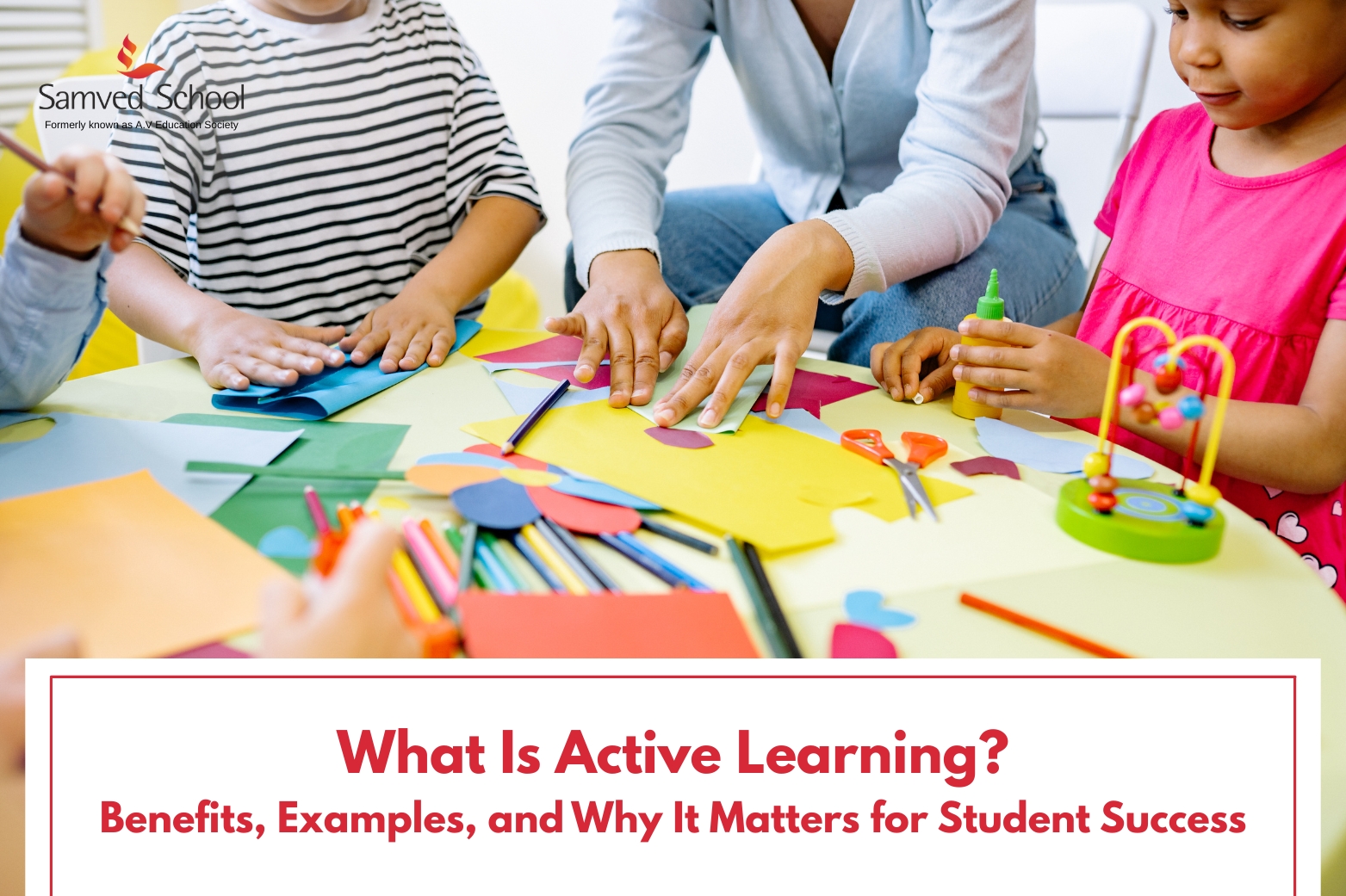
Education is evolving rapidly, and schools today are moving beyond traditional teaching methods that rely heavily on memorization. One of the most effective modern teaching approaches is active learning, which encourages students to participate, think critically, collaborate, and apply concepts in real-life situations.
At Samved School, active and collaborative learning forms an important part of the educational experience. Through the XSEED curriculum and child-centered teaching methods, students are encouraged to engage with concepts through observation, activities, analysis, and application rather than simply memorizing information.
What is Active Learning?
Why Is Active Learning Important?
Active learning helps students develop essential 21st-century skills that extend beyond academics.
- Improves Understanding
- Develops Critical Thinking
- Builds Confidence
- Enhances Problem-Solving Skills
- Makes Learning Enjoyable
Students learn concepts more effectively when they experience and apply them rather than simply memorizing facts.
Active learning encourages students to analyze information, evaluate solutions, and make informed decisions.
Participating in discussions, presentations, and group activities helps students become confident communicators.
Students learn how to approach challenges creatively and develop practical solutions.
Interactive lessons increase student engagement and motivation, creating a positive learning environment.
Examples of Active Learning in Schools
Some common examples include:
Group Discussions
Students share ideas, ask questions, and learn from one another.
Hands-On Activities
Experiments, demonstrations, and practical exercises help students understand concepts more effectively.
Project-Based Learning
Students work on real-world projects that connect classroom learning with practical applications.
Educational Games
Learning through games increases participation and knowledge retention.
Role-Playing Activities
Students develop communication and interpersonal skills through simulations and role-play exercises.
Collaborative Learning
Working in teams teaches cooperation, leadership, and problem-solving skills.
Active Learning at Samved School
Samved School believes that every child learns differently and provides opportunities for active and cooperative learning. The school’s educational philosophy focuses on connecting classroom learning with real-life experiences while supporting the holistic development of every student.
The school follows the XSEED curriculum, which uses a structured 5-step methodology:
- Aim
- Action
- Analysis
- Application
- Assessment
This approach encourages students to experience concepts first-hand, analyze their learning, apply knowledge in practical situations, and develop strong problem-solving skills.”
How Active Learning Supports Holistic Development
Active learning contributes to a child’s overall development by improving:
- Academic performance
- Communication skills
- Leadership qualities
- Creativity
- Emotional intelligence
- Social interaction
- Teamwork abilities
- Decision-making skills
These skills help students succeed both inside and outside the classroom.
Both active learning and traditional learning aim to educate students, but they differ significantly in their approach. While traditional methods focus primarily on teacher-led instruction, active learning encourages students to engage, collaborate, and think critically, leading to deeper understanding and improved retention of concepts.
Active Learning vs Traditional Learning
| Active Learning | Traditional Learning |
|---|---|
| Student-centered | Teacher-centered |
| Encourages participation | Primarily lecture-based |
| Focuses on understanding | Focuses on memorization |
| Develops critical thinking | Emphasizes information recall |
| Promotes collaboration | Limited student interaction |
| Real-world application | Theoretical learning |
Conclusion
Active learning transforms education by making students active participants in their own learning journey. It promotes critical thinking, creativity, collaboration, and confidence while helping students develop a deeper understanding of concepts.
At Samved School, active learning is integrated into everyday teaching through the XSEED curriculum and child-centered educational practices. By encouraging exploration, discussion, and practical application, the school helps students become curious, confident, and lifelong learners prepared for future success.
Frequently Asked Questions (FAQ)
- What is active learning in education?
- Why is active learning important for students?
- What are examples of active learning?
- How does active learning improve academic performance?
- How does Samved School promote active learning?
- Is active learning suitable for all age groups?
- What skills do students develop through active learning?
- How is active learning different from rote learning?
Active learning is a teaching approach where students participate actively through discussions, activities, projects, and problem-solving instead of only listening to lectures.
Active learning improves understanding, critical thinking, communication, confidence, and problem-solving abilities.
Examples include group discussions, hands-on activities, project-based learning, educational games, experiments, and collaborative learning.
Students retain information better when they actively engage with concepts and apply them in practical situations.
Samved School uses active and cooperative learning methods through the XSEED curriculum, which follows the Aim, Action, Analysis, Application, and Assessment approach to learning.
Yes. Active learning can be adapted for preschool, primary, middle school, and high school students to match their developmental needs.
Students develop critical thinking, creativity, communication, collaboration, leadership, and problem-solving skills.
Active learning focuses on understanding and applying concepts, while rote learning focuses primarily on memorization.
Looking for a School in South Bangalore?
Parents searching for quality education in South Bangalore can explore Samved School, a trusted educational institution committed to academic excellence and holistic student development. Conveniently located in JP Nagar 5th Phase, the school provides a nurturing environment where students can learn, grow, and thrive.
Contact Details
Address:
No.13, 17th Cross,
20th Main, J.P. Nagar 5th Phase
Bangalore, Karnataka – 560078
India
Contact Information
Email:
office@samvedschool.in
Phone:
+91 80 2659 0952 / +91 80 2659 0017 / +91 80 2649 1248
📍 Find Us on Google Maps:
https://maps.app.goo.gl/SrHmrmuczoq2tgGT9Whether you’re looking for schools in South Bangalore, schools in JP Nagar, or a state board school in Bangalore that emphasizes active learning and holistic development, Samved School offers a supportive and student-focused educational experience.